
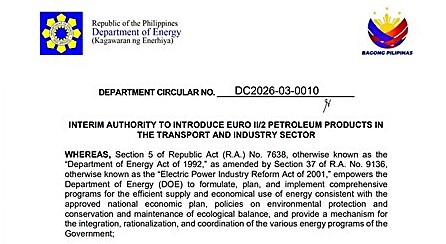
TessDrive has obtained a copy of Department Circular No. DC2026-03-0010 from the Department of Energy (DOE). This order grants “interim authority” to re-introduce Euro II/2 petroleum products into the Philippine market. While the DOE frames this as an emergency measure to ensure fuel supply amidst the escalating Middle East crisis, motorists must weigh the “savings” at the pump against the potential long-term costs to their vehicles and the environment.
Before you pull up to that orange-coded pump, here are eight critical questions we should all be asking:
1. Where will this Euro 2 fuel be sourced, and when does it hit the pumps?
The circular was issued on March 19, 2026, and is effective immediately upon publication in the Official Gazette or a newspaper of general circulation. Oil companies (referred to as downstream oil industry participants) must notify the DOE’s Oil Industry Management Bureau (OIMB) in writing before they can start offering Euro 2 products. We need to know which specific brands and stations will be the first to roll this out.
2. How ‘interim’ is this authority?
The DOE cites “extraordinary circumstances in the Middle East” as the catalyst. However, the circular states it will remain in force “until revoked.” Without a hard expiration date, what specific global market “recovery” markers will trigger a return to strictly Euro 4 standards?
3. How much will our air quality suffer?
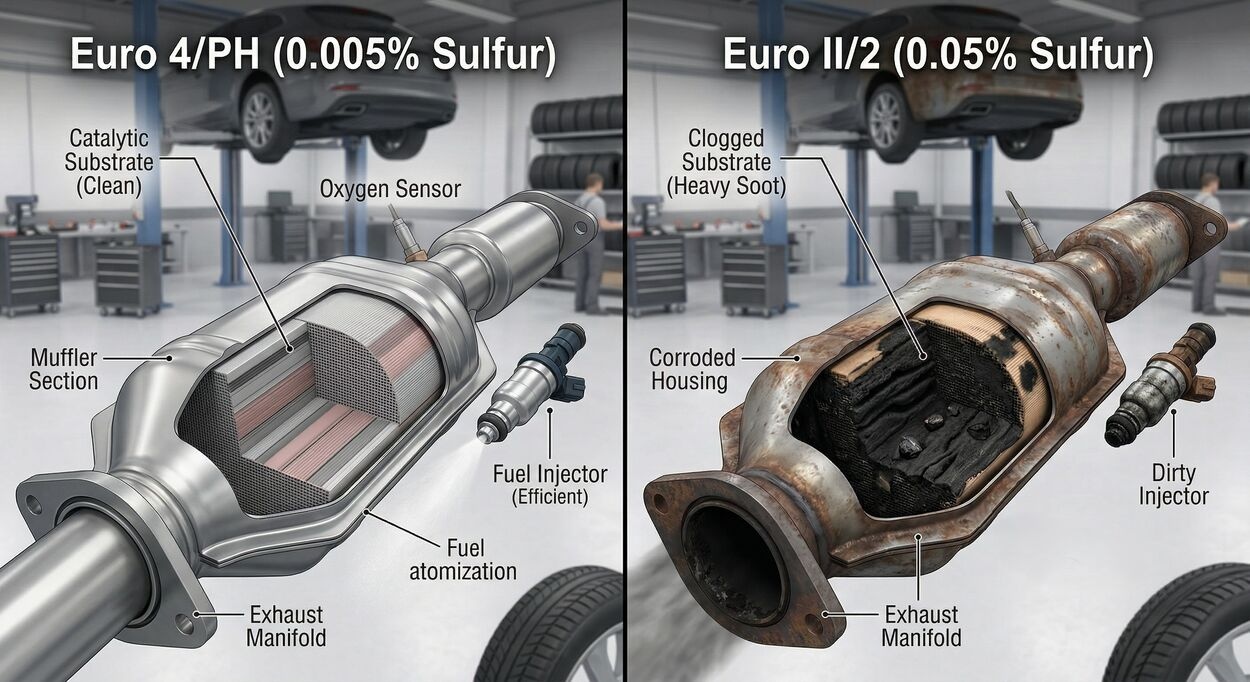
This is a massive step back for the Philippine Clean Air Act. According to the DOE’s own interim specifications, the sulfur limit for Euro 2 gasoline and diesel is 0.05% mass, compared to just 0.005% for Euro 4-PH.
This represents a 1,000% increase (10x) in sulfur content. Sulfur is a primary precursor to sulfur dioxide and particulate matter (PM). Motorists and commuters can expect a visible increase in “black smoke” from older fleets, potentially reversing years of urban air quality gains. Has the DOE coordinated with the DENR to monitor this spike?
4. How can we be sure we aren’t getting ‘accidental’ Euro 2?
The circular mandates dedicated storage tanks and dispensing pumps for Euro 2. However, with “adulteration” listed as a prohibited act, the burden of monitoring falls on the DOE. How frequent will the “random quality sampling” be to ensure that cheaper, high-sulfur fuel doesn’t end up in Euro 4 tanks—either by logistics error or for-profit mixing?
5. What is the ‘hidden cost’ of engine damage?
The DOE explicitly warns that Euro 2 is limited to vehicles from model year 2015 and earlier. If you own a modern car, loading Euro 2 could cause:
o Catalytic converter poisoning: High sulfur “plugs” the catalyst, rendering your emissions system useless and triggering expensive “check engine” lights.
o Fuel system corrosion: Older fuel standards lack the sophisticated additives of Euro 4, leading to carbon buildup on fuel injectors.
o Warranty voiding: Most manufacturers specify a minimum fuel grade. Using Euro 2 in a Euro 4/5/6 engine could give dealers a legal reason to deny warranty claims on engine or exhaust repairs.
6. Does this replace or augment jeepney subsidies?
Traditional jeepneys are specifically eligible for Euro 2. If these drivers opt for the cheaper fuel, will they still be entitled to the government’s existing fuel subsidy programs? If so, the government is essentially subsidizing a return to higher-pollution fuels.
7. What is the ‘Plan B’ if the crisis drags on?
The circular currently limits Euro 2 to specific sectors like industrial use, marine shipping, and older vehicles. If the supply situation worsens, is there a plan to expand this to even newer vehicles, or are there other conservation measures being considered to reduce fuel demand?
8. What is the long-term roadmap for energy security?
While this is a “Bagong Pilipinas” initiative, it relies on an old-world solution. Beyond reverting to 1990s fuel standards, what is the government’s immediate plan to accelerate EV adoption or renewable energy to ensure the Philippine motoring public is never this vulnerable to Middle East volatility again?
How about you, as regular road users, what are your specific plans of action if the prices of fuels continue increasing in the coming months? Do leave your helpful comments in our TessDrive Facebook page.
To read the entire DOE circular, click on this link: https://doe.gov.ph/articles/3374360–department-circular-no-dc2026-03-0010?title=Department%20Circular%20No.%20DC2026-03-0010