
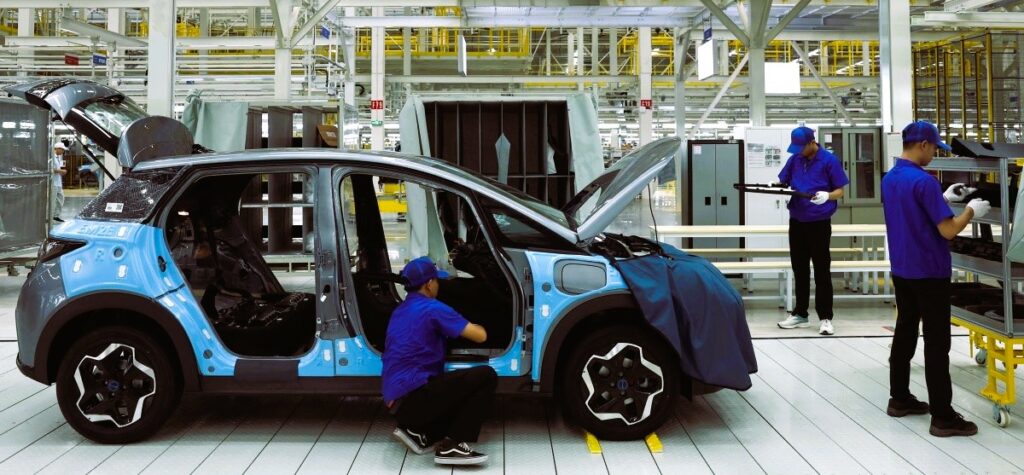
The Electric Vehicle Association of the Philippines (EVAP) has thrown its support behind renewed calls to reinstate funding for the government’s Comprehensive Automotive Resurgence Strategy (CARS) and Revitalizing the Automotive Industry for Competitiveness Enhancement (RACE) programs, warning that the country’s push toward electric vehicles (EVs) will stall without a strong domestic automotive manufacturing base.
While EVAP welcomed the Marcos administration’s aggressive push for electric mobility—through EV incentives, charging infrastructure development, and renewable energy integration—the group stressed that EVs cannot be developed separately from the wider automotive ecosystem.
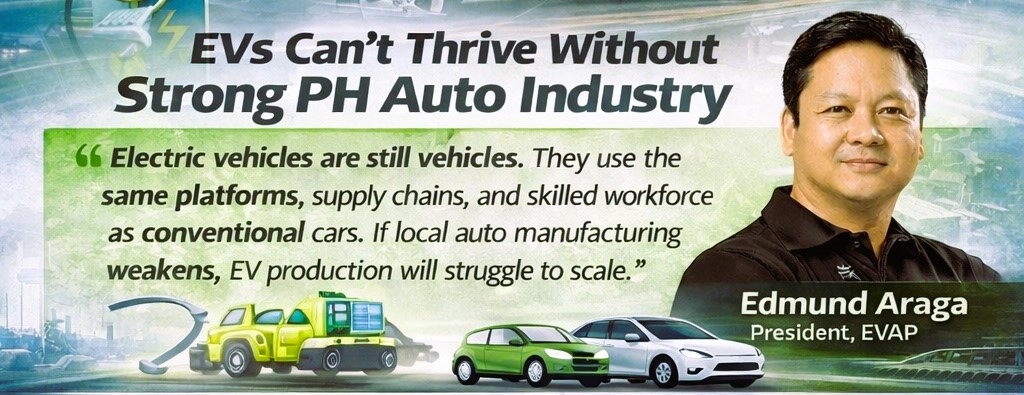
“Electric vehicles are still vehicles,” said EVAP president Edmund Araga. “They use the same platforms, supply chains, production facilities, and skilled workforce as conventional vehicles. If local automotive manufacturing weakens, EV production—local or otherwise—will struggle to scale.”
CARS and RACE were designed to rebuild local vehicle assembly volumes, anchor major OEM investments, and strengthen the domestic parts manufacturing sector. Industry players warn that without these programs, the Philippines risks losing what little scale it has left in automotive production—at a time when neighboring Association of Southeast Asian Nations (Asean) countries are rapidly expanding both internal combustion engine (ICE) and EV manufacturing.
In other countries in the Asean, automotive manufacturing remains one of the largest industrial sectors, supporting hundreds of thousands of jobs and generating billions in exports. These countries are now leveraging their established ICE manufacturing bases—assembly plants, supplier networks, and logistics ecosystems—to attract EV platforms, battery investments, and next-generation mobility technologies.
“The pattern is very clear,” Araga said. “No country jumped straight into EVs without first building volume and capability in conventional automotive manufacturing. EVs are not a replacement for the auto industry—they are its evolution.”
EVAP emphasized that local vehicle assembly is critical not only for producing cars, but also for sustaining parts manufacturing such as wiring harnesses, electronics, body panels, thermal systems, and eventually batteries and power electronics. Without sufficient production volume and long-term policy support, investments in these components become commercially unviable.
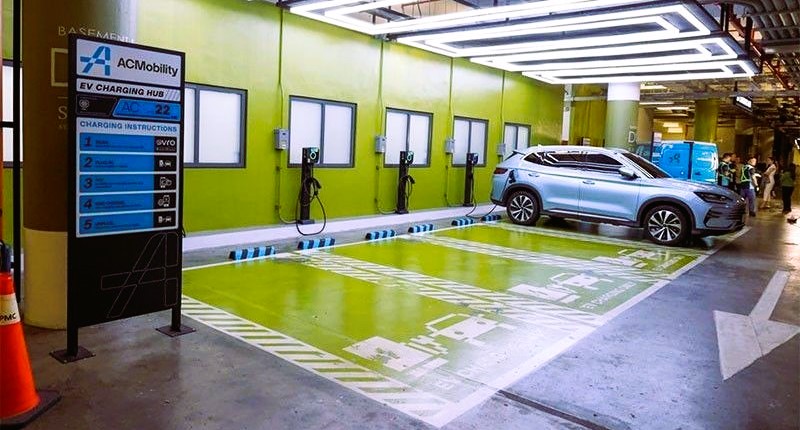
For the motoring industry, the concern is straightforward: Fewer locally assembled vehicles mean higher dependence on imports, weaker supplier networks, and fewer opportunities to localize future EV models. This, EVAP warned, could leave the Philippines permanently behind as Asean transitions to electrified platforms.
While reaffirming its support for the government’s EV roadmap, EVAP called for a balanced transition strategy that allows ICE vehicles, hybrids, and EVs to coexist while local manufacturing scale is rebuilt.
“Supporting CARS and RACE today strengthens our ability to assemble EVs locally tomorrow,” Araga said. “If we want Philippine-made EVs in the future, we must first protect and grow Philippine automotive manufacturing today.”
President Ferdinand Marcos Jr recently vetoed the P4.5-billion allocation for the CARS and RACE programs in the 2026 national budget, stating that “unprogrammed appropriations” must be restricted to essential priorities to enforce fiscal discipline. The veto effectively removes the funding intended to settle government incentive arrears owed to manufacturers like Toyota and Mitsubishi for production targets they have already met, while also stalling the launch of the successor RACE program.
EVAP said it is ready to engage in constructive dialogue with government economic managers, lawmakers, and regulators to explain how CARS and RACE directly support jobs, investments, and the long-term competitiveness of the Philippine automotive industry—whether powered by gasoline, hybrid systems, or electricity.
To know more about EVAP, visit its official website https://www.evap.com.ph/