By Tessa R. Salazar and Aries B. Espinosa
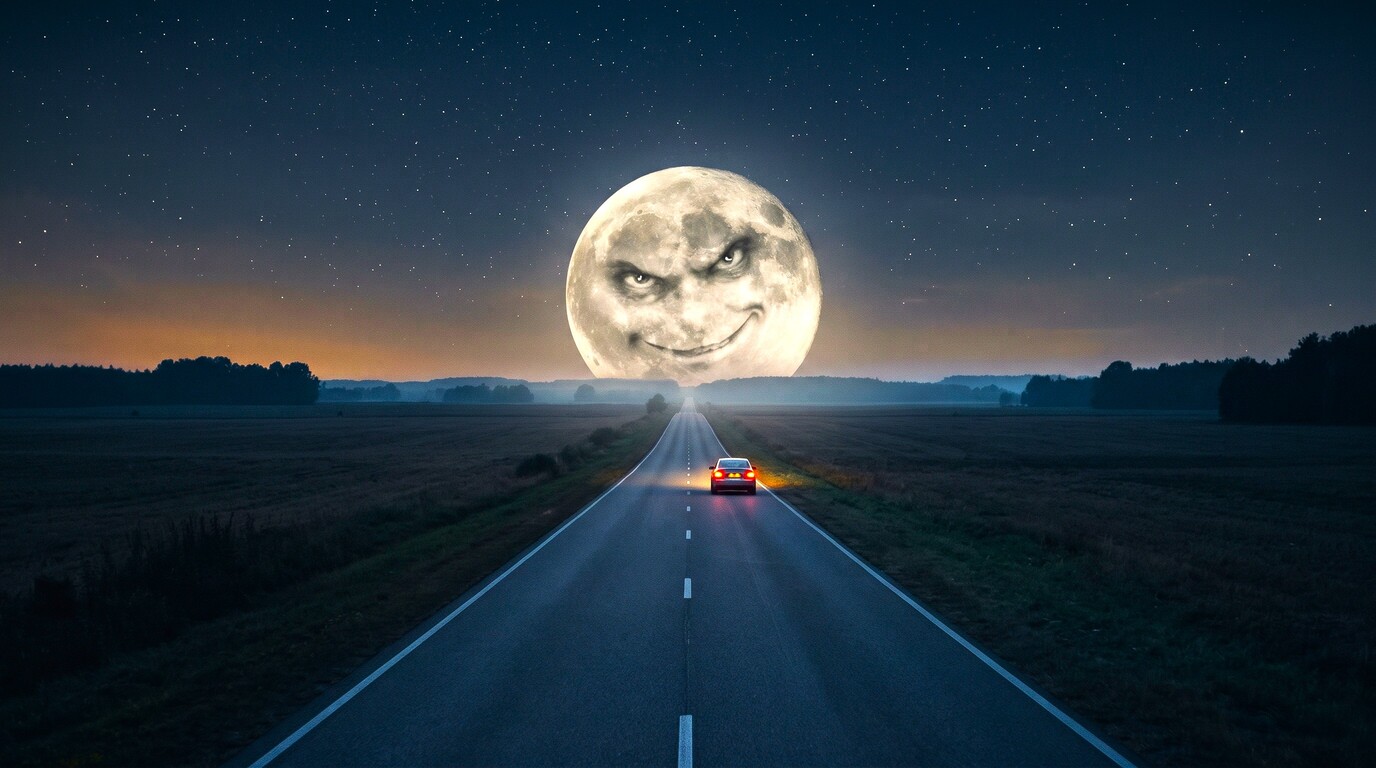
It’s that time of the year when the living intersects with the dead, reality slips into the “Twilight Zone,” and Filipino drivers blame supernatural forces instead of faulty alternators. Whatever it is, it defies physics, logic, and standard roadside insurance claims.
In our decades of being road users, driving all sorts of vehicles on four wheels (and sometimes even two and three) for fun and for a living, and running on roadside-bought peanuts, we’ve gathered our fair share of road stories. Many give us goosebumps; a few made us question our life choices. Here are four true encounters from our TessDrive archives that prove that sometimes, often in the dead of night, you share the road with something else other than drunk drivers and sweet potatoes.
1. The lost hour on Tagaytay Ridge
(As told by Aries)
Youth is a special kind of armor that makes you feel utterly indestructible. In the summer of 1991, during my junior year in college, 20 of us packed like canned sardines into three cars to chase the sun down to Nasugbu, Batangas. I was piloting my family’s venerable and trusty Toyota TownAce in our 3-vehicle convoy sandwich. The trip down was loud, sun-drenched, and entirely normal.
The trip back was where reality filed for a temporary leave of absence.
By 5 p.m., we headed home, with one car leading, my TownAce in the middle, and our sweeper car bringing up the rear. But as dusk blanketed the winding Tagaytay roads, the convoy stretched out. Soon enough, our van was alone in the gathering fog and darkness.
Back in 1991, the Tagaytay ridge wasn’t the neon-lit carnival of Starbucks, boutique Airbnbs, and weekend gridlock it is now. It was pitch-black, chilly, and desolate. Just past 7 p.m., a familiar oasis appeared: Mushroom Burger. The lights were humming, and people were bustling inside. Relieved, I pulled onto the shoulder to let our sweeper catch up.
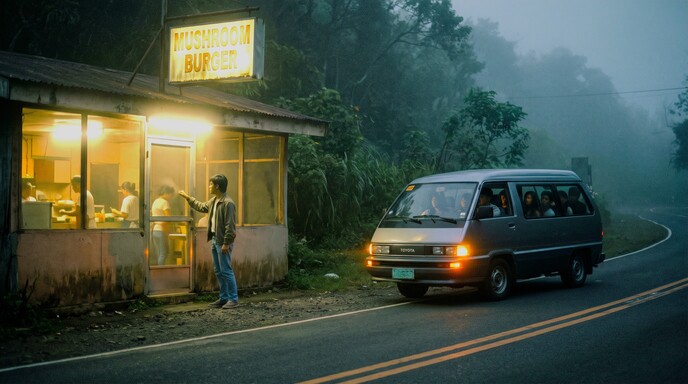
Fifteen minutes ticked by. No headlights behind us. My passengers were getting restless, so I walked over to Mushroom Burger to use the restroom.
Through the screen door, bathed in bright fluorescent light, the staff were moving with bizarre, slow-motion choreography, wiping down counters and gliding between tables. I knocked. Silence. I hammered on the frame, yelling, “Excuse me! Makiki-CR lang po!”
Nobody flinched. Nobody looked up. It was like shouting into an acoustic vacuum. A cold wave rolled down my neck. Realizing that begging invisible fast-food workers was getting me nowhere, I surrendered, retreated into the darkness, and watered some roadside foliage instead.
By now, 20 minutes had passed. Still no sweeper car. Every instinct screamed that it was time to leave.
Ten minutes down the road, the unexpected happened: The TownAce’s engine coughed, sputtered, and died. Dash lights went pitch-black. We were stranded, surrounded in darkness and the kind of quiet that makes you hear your own heartbeat. I turned the key, and the starter wheezed before grudgingly kicking over—only to stall again two kilometers later. And again.
For the third time, I started the engine, which begrudgingly obeyed. By this time, the boisterous beach road-trippers in the van were now wide-eyed mutes. I tried breaking the ice: “Hey, at least the brakes still work!” Nobody laughed.
Suddenly, a frantic scream sliced through the tension: “Pull over!”
It was one of our female friends seated at the rear. I threw the van onto the shoulder, the sliding door was wrenched open, and she stumbled out, violently hurling into the weeds. We sat in mortified silence, breathing in an aromatic blend of mountain air and digestive distress. After a few agonizing minutes, she climbed back in, whispering an apology.
The second that door clicked shut, I turned the ignition. The engine fired up instantly, purring like it was brand new. It didn’t stutter once for the rest of the highway run.
This bizarre story pieced itself together Monday at school when all three carloads finally met up to compare notes:
The phantom restaurant: Both the lead car and the sweeper swore that Mushroom Burger was dead, pitch-black, and chained shut when they drove past. The sweeper never saw us because, to their eyes, an entire Toyota TownAce simply wasn’t there.
The ghost in the machine: Our mechanic gave the van a clean bill of health on Tuesday. The fuel gauge wasn’t near empty; the tank was over half full. There was zero mechanical explanation for the stalling.
The lost-in-translation moment: My sick friend swore she never yelled in English. She and everyone else in the van distinctly remembered her screaming in pure Tagalog panic: “Para! Para!” Apparently, only my ears got the subtitled Hollywood translation.
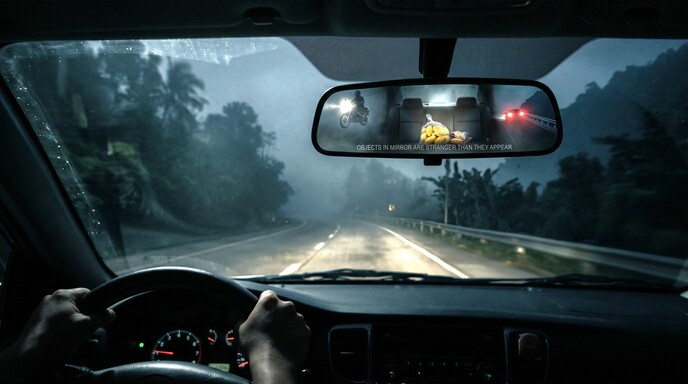
The fare payment: While vacuuming the van the next morning, I found an unmarked plastic bag wedged beneath the rear bench containing about a kilo of ripe mangoes. Nobody in our group bought fruit. No roadside vendors were open in the middle of nowhere. When my family sliced them up, they turned out to be the sweetest, juiciest mangoes any of us have ever tasted.
The missing hour: When we checked time stamps, my passengers and I were baffled. Every single one of our analog and digital watches was synchronized—and running exactly one full hour behind everyone else’s.
Did the electromagnetic anomalies of the ancient Taal caldera pull us into a parallel dimension? Or did we inadvertently pick up an engkanto hitchhiker who messed with our ignition, got thoroughly nauseated by my friend, bolted into the bushes, and left a tip in seasonal produce?
All I know is that somewhere on that dark ridge in 1991, an hour vanished from our lives. I’m still waiting to see if it ever gets credited back.
2. The airborne rider of E. Rod
(As told by Tessa)
Metro Manila evening rush hour is an everyday purgatory, but August 2005 near the intersection of Araneta and E. Rodriguez was especially punishing. We were sealed inside a sedan, crawling millimeter by millimeter through the classic humid Manila smog. The endless hum of idling ICEs was nearly putting me into a trance as I sat back in resignation behind the wheel.
A sudden, sharp gasp from one of the passengers jolted me to attention. “What the hell…”
The guy who said that seemed really tensed up, as he stared directly out and slightly up from the windshield—not at the bumper ahead, but above it.
I leaned forward. Floating roughly 10 feet in mid-air, levitating over a sea of stalled cars and PUVs, was a headlight.
Before my brain could rationalize it as a bizarre optical reflection, the light drifted, and the silhouette resolved: It was a motorcycle. Straddling it was a semi-translucent figure in a retro leather jacket and full helmet, completely unbothered by gravity.
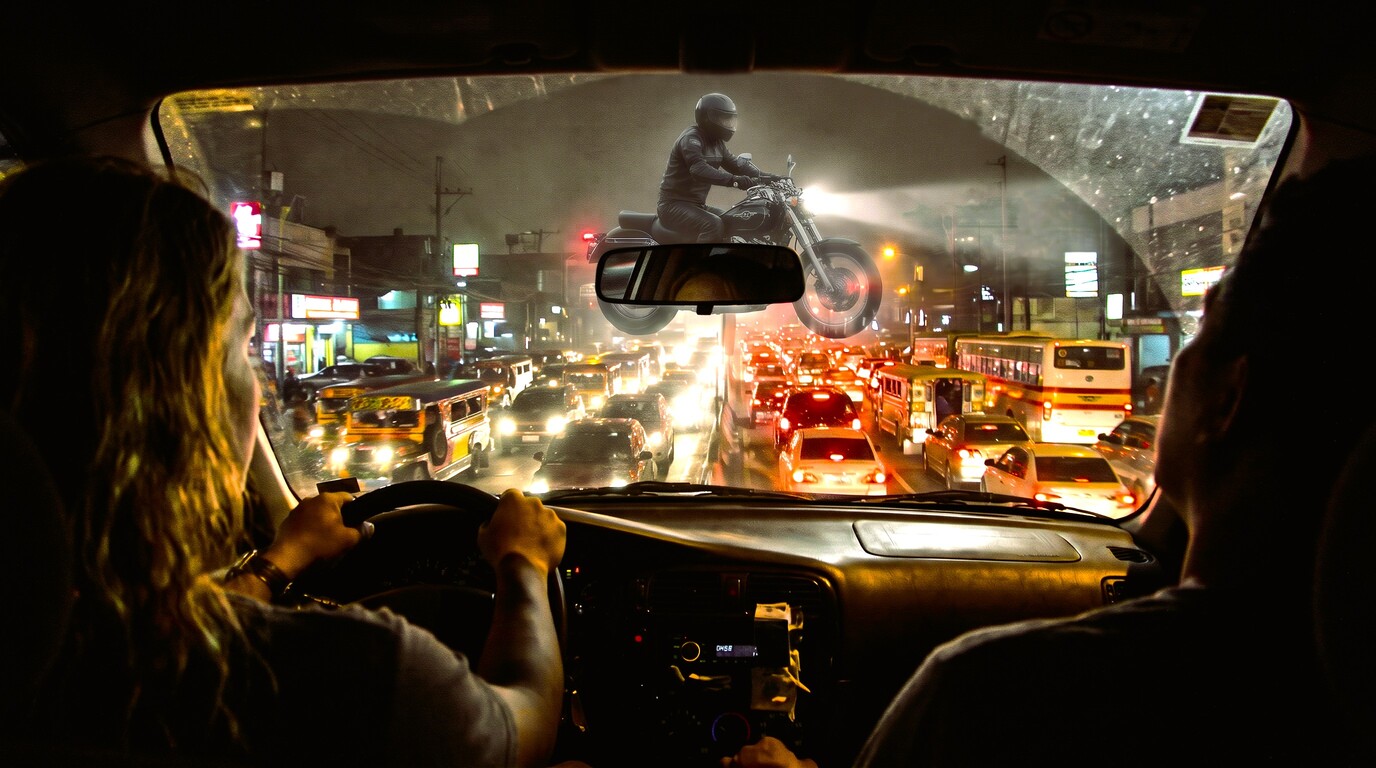
For what felt like 10 seconds, the phantom bike hovered silently across the entire intersection, cutting through the smog and exhaust haze while hundreds of car horns blared below. The rider never looked down, gliding past like an ethereal VIP skipping the Quezon City traffic jam entirely.
My front passenger unleashed an impressive string of expletives. The bike glided across the road, its dim red taillight fading away into thin air.
The silence that followed was unnerving. Finally, I whispered into the steering column: “Tell me you saw that. Please tell me you saw that.”
The two of them just nodded dumbly.
The crowning irony? We were three seasoned motoring journalists returning from an official press vehicle launch. On our laps sat tens of thousands of pesos worth of high-end DSLR cameras with telephoto lenses. And not a single one of us had the presence of mind to take off a lens cap and shoot the flying rider.
3. Antique’s shortcut to nowhere
(As told by Aries)
On the evening of June 10, 2014, Tessa and I were gunning down the coastal highway of Antique Province. We had just driven out of Iloilo City, trying to beat the clock to catch the RoRo barge from Caticlan over to Bulalacao, Mindoro. It was the tail end of our grueling 11-day Luzon-to-Mindanao road trip. We were tired, road-weary, and surviving entirely on cold water and sweet suman cassava.
Provincial roads after 7 p.m. empty out fast. On this moderately twisty coastal stretch, flanked by a sheer cliffside on one side and black coastline on the other, there was only our subcompact and a small hatchback about 10 car lengths ahead.
We followed its red taillights faithfully for a few minutes at an easy 50 to 60 kph, using it as our de facto road scout. Then, with zero brake lights and zero hesitation, the hatchback threw itself into a hard, 90-degree right turn and evaporated.
Three seconds later, our headlights swept over the exact same spot.
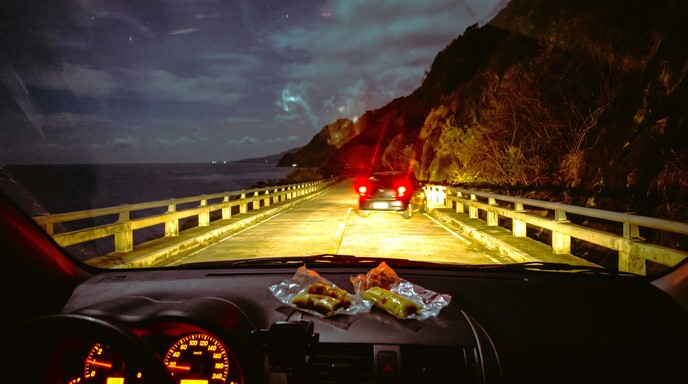
There was no intersection. There was no turn-off. We were crossing an elevated concrete bridge over a deep ravine, bordered by solid waist-high guardrails and backed directly into the craggy, impassable face of a mountain. If a car had actually made that turn, it would have either plowed straight into solid rock or plunged into the gorge. But there was no sign of damage on the guardrails.
Tessa and I didn’t say a word for several kilometers, both of us gently laying off our snacks.
When we shared the story later, a local mentioned that the exact bridge had been the site of a tragic accident years before. Did we just tail a phantom commuter reliving its final drive? Quite possibly. Our biggest what-if: That road trip took place right before dashcams became a thing in this country.
4. Where dead cars speak
(As told by Tessa)
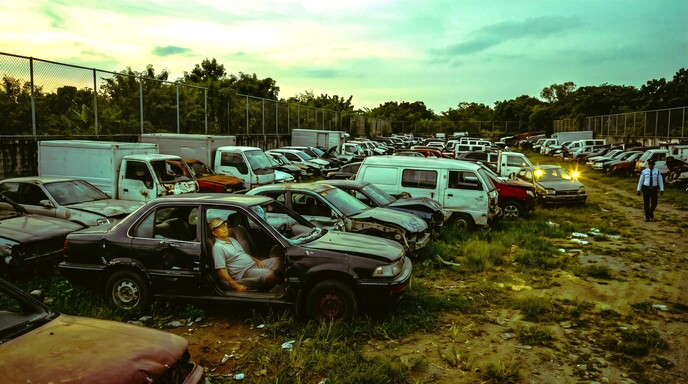
In October 2006, I investigated a sprawling two-hectare impound yard in Pulilan, Bulacan, for a story for the Philippine Daily Inquirer. Among patrolmen and wrecker crews, the place had earned an unceremonious nickname: The graveyard of North Luzon Expressway crashes.
Walking through the yard in the midday heat, the sensory overload wasn’t just visual—it was the heavy, metallic stench of dried blood, rusted steel, and scorched rubber drifting off a tangled wreck that had just been dragged through the gates. The driver had fallen asleep at highway speeds.
For the mechanics and guards stationed there overnight, surrounded by hundreds of shattered windshields and twisted chassis, the scrap metal had a habit of refusing to rest:
Dead, battery-less sedans routinely blared their horns at 2 a.m.
Completely gutted chassis with cut wiring harnesses would abruptly flash their headlights.
In the barracks, shower faucets would suddenly turn wide open while all crew members were sitting together outside on duty.
One highway recovery specialist recalled an All Souls’ Day retrieval where a crumpled delivery truck was towed into the yard after a fatal rollover. As it rolled through the gates, the horn shorted out—or woke up—blaring a relentless, ear-splitting scream. The exasperated mechanic popped the mangled hood latch and severed the thick battery cables with heavy shears.
The horn didn’t stop. It kept screaming into the midnight silence, running on pure spite and zero volts.
On another morning, a commuter stopped by to collect personal belongings from his overheated utility van. He returned to the guardhouse annoyed, asking why management let another driver “loiter and sleep” inside the bloody, crushed sedan parked right next to his van. He described the man clearly: Blue checkered shirt, khaki baseball cap, slumped sideways against the broken steering column.
The guards accompanied him back to check. The mangled cabin was completely empty.
When the motorist repeated his description, the guards went quiet. The faded checkered polo and baseball cap were the exact clothes worn by the casualty when emergency crews extricated his remains two days earlier.
We share road ghosts over dinner to laugh off the goosebumps and stay alert through the hypnotic hum of long provincial drives. But walking through tons of crushed steel reminds you of a simpler truth: Those spirits are sobering warnings left behind by motorists whose journeys ended mid-trip.
It’s far better to hear a ghost story—or even spot an apparition floating harmlessly over your bumper—than to wind up as the next permanent resident of an impound lot. When your eyelids feel heavy, when highway hypnosis sets in, or if you’ve had a few drinks: Swallow your pride, pull into the nearest well-lit gas station, and sleep it off. The ghosts will keep, and the road will still be there in the morning.