

Molecular biologists from the University of the Philippines Diliman (UPD) have uncovered critical cellular evidence showing that electronic cigarette vapor triggers tumor-promoting behaviors in human lung cells. The findings directly challenge widespread public assumptions that vaping is a benign substitute for combustible tobacco.
Conducted at the Disease Molecular Biology and Epigenetics Laboratory (DMBEL) of the UPD College of Science’s National Institute of Molecular Biology and Biotechnology (UPD-CS NIMBB), the research team—comprising Daniel Angelo R. Mirador, Jose Lorenzo M. Ferrer, Kim Denyse Hao Lin, and Dr. Reynaldo L. Garcia—identified and characterized a novel regulatory molecule they named vape-associated lncRNA transcript 1 (VALT1).
Published in the peer-reviewed open-access journal Non-Coding RNA (Volume 12, Issue 2, 2026), the study illuminates how e-cigarette aerosols alter the genetic expression (transcriptome) of human respiratory cells.
The cellular ‘Double Jeopardy’
Long noncoding RNAs (lncRNAs) are segments of RNA that do not translate into proteins; once dismissed by early geneticists as “genomic junk,” they are now recognized as master regulators of cellular physiology and disease progression.
Dr. Reynaldo Garcia’s laboratory previously established in a 2021 Scientific Reports study that conventional cigarette smoke activates a related molecule—smoke- and cancer-associated lncRNA transcript 1 (SCAL1)—which shields DNA-damaged cancer cells from dying. In their 2026 investigation, the UPD team sought to determine whether e-cigarette vapor initiates a comparable biological hazard.
“In an earlier study that we published in Scientific Reports, we reported that the long noncoding RNA called smoke- and cancer-associated lncRNA transcript 1 (SCAL1) ensures the survival of cancer cells whose DNA has been damaged by cigarette smoke. It does so by detoxifying cells of reactive oxygen species (ROS) that would otherwise lead to cell death. This creates a paradox: Instead of dying, the damaged cells persist, which can promote cancer development—creating a kind of double jeopardy. The motivation for this study was to ask whether a similar mechanism also occurs with vaping: Can vape exposure trigger changes in cells that, like cigarette smoke, allow damaged cells to survive?”—Dr. Reynaldo L. Garcia, principal investigator, UPD-CS NIMBB
Key lab findings
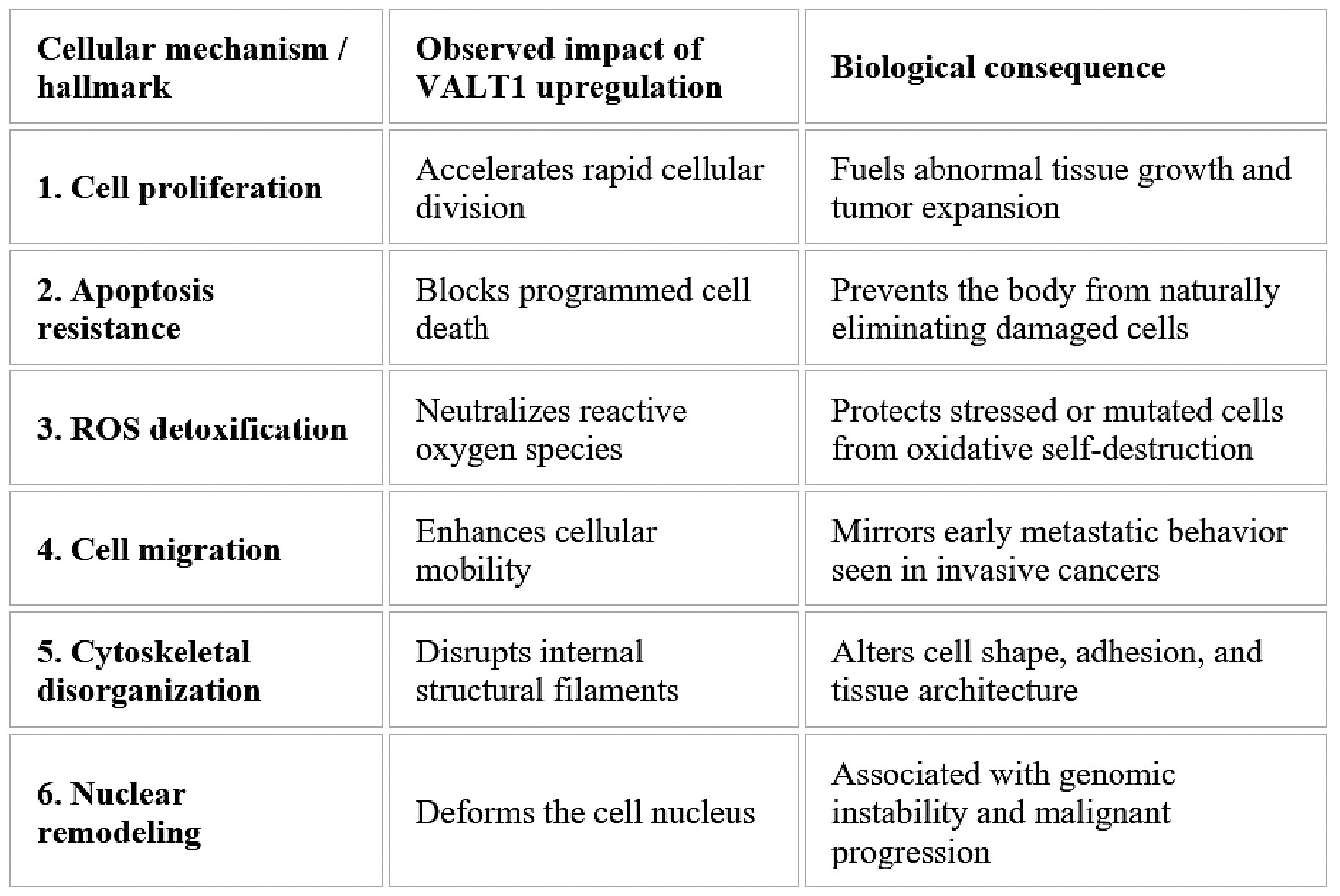
Using human lung adenocarcinoma cells (A549) alongside normal human bronchial epithelial cells (BEAS-2B), the researchers analyzed RNA-sequencing datasets and exposed cell cultures to e-cigarette smoke extract (eCSE). Their experiments revealed 6 distinct tumorigenic shifts driven by VALT1:
Critical experiment takeaways
Elevated in real-world users and tumors: Analysis of clinical RNA-seq datasets confirmed that VALT1 is naturally elevated in the oral epithelial cells of real-world e-cigarette users as well as in non-small-cell lung cancer (NSCLC) tumors.
Independent tumorigenic driver: Remarkably, artificially overexpressing VALT1 in lab cells reproduced these cancer-like traits even without direct exposure to e-cigarette vapor, whereas silencing (knocking down) VALT1 suppressed them.
Selective survival advantage: Under toxic chemical stress, VALT1 promoted cell survival specifically in cancerous lung cells (A549) rather than healthy bronchial cells (BEAS-2B)—effectively aggravating malignant traits even before classic DNA mutations take hold.
“This provides evidence that vaping is not safe, and that its harmful effects are mediated, at least partly, by VALT1. Our cells assume tumorigenic properties upon exposure to e-cigarettes. Beyond its health implications, this work also contributes to our knowledge of non-coding RNA biology.”—Daniel Angelo R. Mirador, lead author, UPD-CS NIMBB/UP College of Medicine
Rising youth vaping and public health urgency
The UPD-CS NIMBB study arrives at a critical juncture for Philippine public health. While e-cigarettes are frequently marketed as reduced-harm cessation aids, epidemiological data show rapid adoption among Filipino youth and dual-use patterns among adults.
Alarming youth uptake: Data from the Global Youth Tobacco Survey (GYTS) indicate that roughly 1 in every 7 Filipino students (14%, or over 1.2 million youth) actively use e-cigarettes, with recent 2026 global survey findings highlighting that some Filipino children initiate smoking or vaping before age 10.
The ‘reduced harm’ misconception: According to a survey by the Johns Hopkins Institute for Global Tobacco Control (IGTC) on Filipino adults who smoke, 70% believed e-cigarettes were less harmful than combustible cigarettes, while 7 out of 10 adult vapers practiced “dual use”—consuming both traditional cigarettes and vapes concurrently.
Latency period warning: Because lung carcinogenesis involves a decades-long induction and latency window, and modern e-cigarettes have only been widely used for roughly 15 years, molecular biomarkers like VALT1 serve as vital early-warning indicators long before population-level cancer statistics peak.
To know more about this and other studies undertaken by UP scientists, log on to https://science.upd.edu.ph/. (Original story courtesy of Eunice Jean C. Patron / UPD-CS Science Communications)
Top image shows a molecular biologist from the UP Diliman College of Science investigating how the use of e-cigarettes may affect cancer-related cellular processes (Photo by Daniel Angelo Mirador).