

By Tessa R. Salazar
It’s common knowledge that Filipino drivers often take coffee to stay alert and manage sleepiness during long hauls or while stuck in the Philippines’ notorious traffic jams. Statistics show that 8 out of 10 Filipinos consume an average of 2.5 cups of coffee daily. Whether you’re a driver or not, if you’re Filipino, coffee is more than just a caffeine fix; it is a social bridge. As friends, acquaintances, or co-workers often say: “Kape muna tayo (Let’s have coffee first).” This is a moment of social wakefulness, a community connection before focusing on the tasks at hand.
Coffee can also be a statement of identity and pride of place. For instance, in southern Tagalog (Batangas and Cavite provinces), drivers prefer taking “kapeng barako”—a strong, pungent local variety of Liberica coffee known for its strong “kick.”
Kapeng barako, also known as the Philippine Liberica coffee, is recognized for its ability to sharpen the mind, primarily due to its high caffeine content, which increases alertness, mental focus, and concentration.
So, if you’re a driver who drinks over two cups of coffee a day to help you stay awake during long road trips, here’s more good news: Drinking caffeinated coffee could help reduce the risk of developing dementia.
Tracking 130,000 adults for 43 years
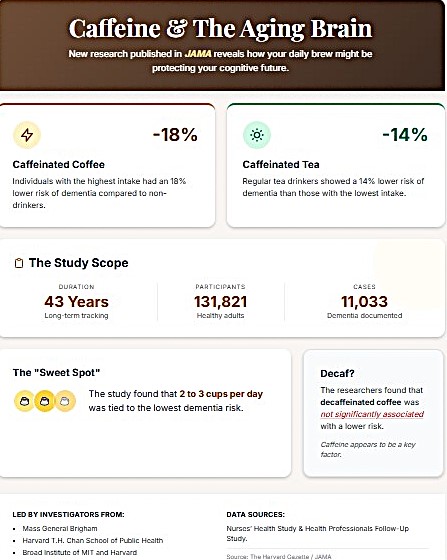
Researchers have shown that drinking two to three cups of coffee a day is tied to a lower dementia risk. The data also suggests that caffeinated tea helps slow cognitive decline. Imagine the scope of this study: For up to 43 years, researchers tracked more than 130,000 healthy adults. Those who regularly drank two to three cups of caffeinated coffee (or caffeinated tea) per day had a lower dementia risk than those who drank little or none of these beverages.
The Harvard Gazette reported that among the participants, individuals who drank the most caffeinated coffee had about an 18% lower risk of dementia compared to low or non‑drinkers. For tea drinkers, those with the highest intake had a 14% lower risk than those who drank the least.
The study was published recently in the Journal of the American Medical Association (JAMA). Led by investigators from Mass General Brigham, the Harvard TH Chan School of Public Health, and the Broad Institute of MIT and Harvard, the team analyzed 131,821 participants from the Nurses’ Health Study and the Health Professionals Follow-Up Study.
The study addressed the following query: Is long-term intake of caffeinated and decaffeinated coffee associated with the risk of dementia and cognitive outcomes?
The findings show significant correlation: In this prospective cohort study of 131,821 individuals with up to 43 years of follow-up, 11,033 dementia cases were documented. Higher caffeinated coffee intake was significantly associated with a lower risk of dementia. Decaffeinated coffee intake was not significantly associated with dementia risk.
The results meant higher caffeinated coffee intake was associated with more favorable cognitive outcomes.
The Harvard Gazette quoted Daniel Wang, associate scientist with the Channing Division of Network Medicine at Mass General Brigham and assistant professor at Harvard Medical School, on Feb. 9: “When searching for possible dementia prevention tools, we thought something as prevalent as coffee may be a promising dietary intervention—and our unique access to high-quality data through studies that have been going on for more than 40 years allowed us to follow through on that idea.” Wang is also an assistant professor in the Department of Nutrition at Harvard Chan School and an associate member at the Broad Institute.
“Coffee and tea contain bioactive ingredients like polyphenols and caffeine, which have emerged as possible neuroprotective factors that reduce inflammation and cellular damage while protecting against cognitive decline,” the Harvard Gazette reported. “Though promising, findings about the relationship between coffee and dementia have been inconsistent, as studies have had limited follow-up and insufficient detail to capture long-term intake patterns, differences by beverage type, or the full continuum of outcomes—from early subjective cognitive decline to clinically diagnosed dementia.”
“Data from the Nurses’ Health Study and Health Professionals Follow-Up Study help to overcome these challenges,” Mass General Brigham Communications added. “Participants repeated assessments of diet, dementia, subjective cognitive decline, and objective cognitive function, and were followed for up to 43 years. Researchers compared how caffeinated coffee, tea, and decaffeinated coffee influenced dementia risk and cognitive health of each participant.”
In its “Conclusions and Relevance” section, JAMA wrote: “Greater consumption of caffeinated coffee and tea was associated with lower risk of dementia and modestly better cognitive function, with the most pronounced association at moderate intake levels.”
18% lower risk of dementia
The Harvard Gazette (https://news.harvard.edu/gazette/) further noted: Of the more than 130,000 participants, 11,033 developed dementia. Both male and female participants with the highest intake of caffeinated coffee had an 18% lower risk of dementia compared with those who reported little or no caffeinated coffee consumption. Caffeinated coffee drinkers also had a lower prevalence of subjective cognitive decline (7.8% versus 9.5%). By some measurements, those who drank caffeinated coffee also showed better performance on objective tests of overall cognitive function.
The article also noted: “Higher tea intake showed similar results, while decaffeinated coffee did not—suggesting that caffeine may be the active factor producing these neuroprotective results, though further research is needed to validate the responsible factors and mechanisms.”
It added: “The cognitive benefits were most pronounced in participants who consumed two to three cups of caffeinated coffee or one to two cups of tea daily. Contrary to several previous studies, higher caffeine intake did not yield negative effects—instead, it provided similar neuroprotective benefits to the optimal dosage.”
“We also compared people with different genetic predispositions to developing dementia and saw the same results—meaning coffee or caffeine is likely equally beneficial for people with high and low genetic risk of developing dementia,” said lead author Yu Zhang, a student at Harvard Chan School and a research trainee at Mass General Brigham.