
By Tessa R. Salazar
How will a Philippine President be judged by history? Will one of the criteria be how he (or she) has kept our society on track to progress? Perhaps, when it comes to the state of our railways, that metric takes on a quite literal sense.
Some of the major highlights of President Ferdinand Marcos Jr’s July 27 State of the Nation Address (SONA) focused on anti-corruption and flood control investigations, noting that over P25 billion in cash, assets, and frozen funds were preserved or recovered from anomalous projects, with more than P800 million immediately returned to the National Treasury. He also addressed energy utility charges, directing regulators to ensure unfair system loss costs are not passed on to monthly consumer bills. On economic relief and agriculture, the administration pushed for targeted tax relief for lower-income individuals and MSMEs (micro, small, and medium enterprises), while highlighting record rice yields alongside crackdown efforts against agricultural smugglers and hoarders. Additionally, the President called for stronger legal and institutional protections for children against cyberbullying, online toxicity, and hate culture.
Another critical SONA highlight was mass transportation, specifically the country’s railway system.
While recent incentives granted to electric vehicles (EVs) primarily benefit a small minority, given that only 6% of Filipino households own a private car, the economic impact of traffic congestion across the country remains staggering. What should truly earn the country’s chief executive high marks among his people is a truly efficient mass transport system, which essentially includes a functional, high-capacity railway network.
The President announced in his SONA that two major railway projects will begin partial operations by 2027: The North-South Commuter Railway (NSCR) Valenzuela-to-Malolos segment, and the Metro Rail Transit Line 7 (MRT-7), covering its first 12 stations from North Avenue to Sacred Heart in Quezon City, with future extensions planned toward San Jose del Monte, Bulacan.
The President needs to get these projects moving as promised, because if we’re talking about the mantra “for the good of the majority,” then there’s no more glaring example than mass transport. Roughly 94% of households in the Philippines do not own a car. Only 41% own a motorized 2-wheeler, while 24% own a non-motorized vehicle, like a bicycle. The vast majority of Filipinos cannot afford a private 4-wheeled car, let alone an electric car. Mobility choices are strictly driven by basic affordability (walking, bicycles, motorcycles, or e-trikes).
This reality raises a fundamental question: When will the country finally establish a widespread, efficient, clean, and accessible public railway network?
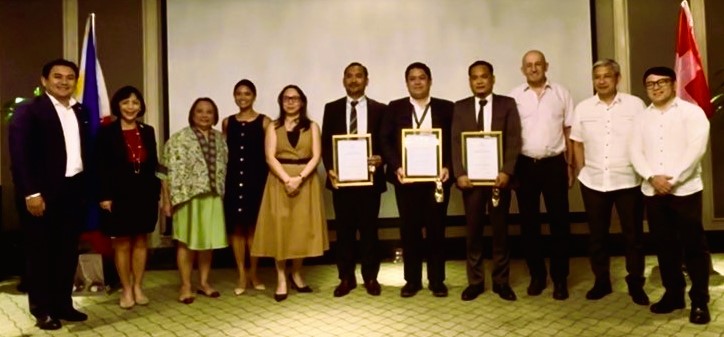
Four days before the SONA, our TessDrive team attended the July 23 Policy-to-Practice roundtable session titled “Advancing Sustainable and Efficient Urban Mobility” at the Makati Diamond Residences, hosted by the Swiss Chamber of Commerce of the Philippines (SwissCham Philippines) and the All Transport Network (ATN). The forum convened government officials, infrastructure experts, and private-sector leaders to address Metro Manila’s mobility crisis through strengthened public-private collaboration.
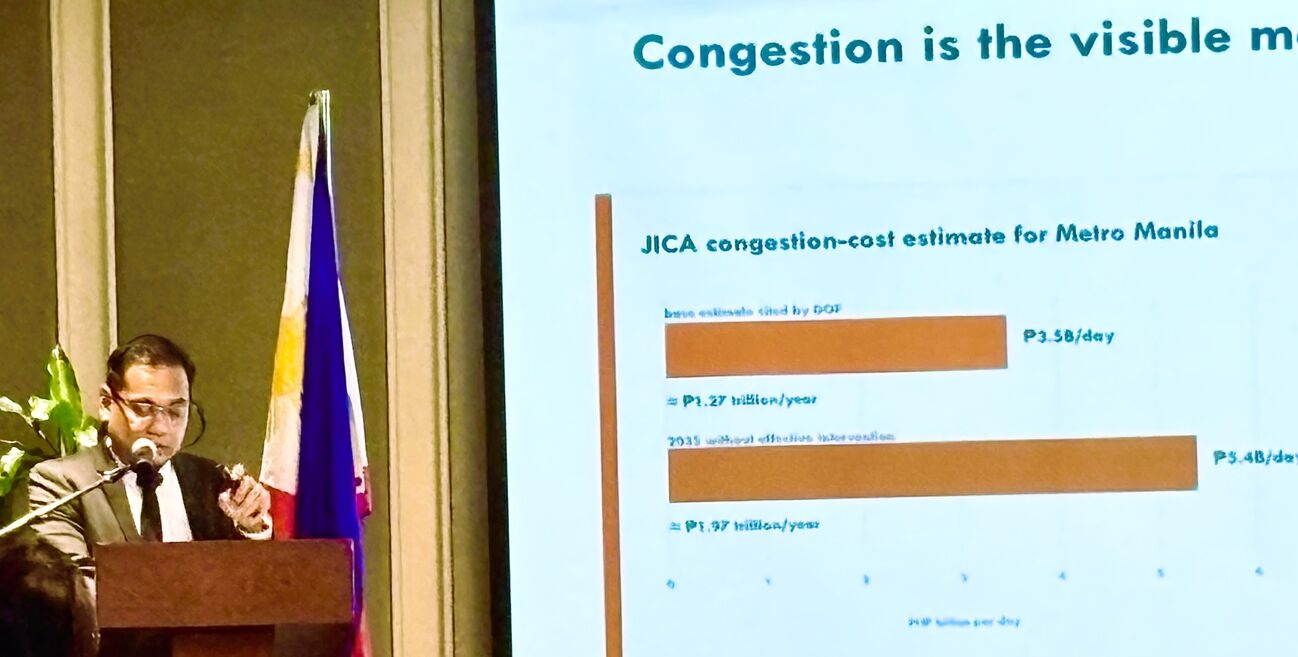
The discussion came at a pivotal moment. The Japan International Cooperation Agency (JICA) estimates that traffic congestion in Metro Manila currently costs the Philippine economy approximately P3.5 billion per day—a loss projected to surge to P5.4 billion daily by 2035.
Department of Transportation (DOTr) Undersecretary for Railways Atty. Timothy John R. Batan served as keynote speaker, presenting updates on flagship initiatives like the NSCR and the Metro Manila Subway Project while detailing their roles in boosting national productivity. Joining the panel, Philippine National Railways (PNR) General Manager Deovanni S. Miranda addressed operational realities during ongoing modernizations, while Asian Transport Observatory co-team leader Alvin Mejia provided regional benchmarks on urban transport performance across Southeast Asia.
Elaborating on economic metrics, Mejia noted that JICA’s oft-cited P3.5 billion daily loss (which factors in lost time alongside vehicle operating expenses) translates to approximately P2.2 trillion per year.
“And this is based on previous baseline data from around 2017 to 2020,” Mejia explained. “This figure is expected to increase moving forward.”
Citing data from the TomTom Traffic Index, which aggregates floating car GPS metrics from hundreds of global cities to evaluate travel times and congestion levels, Mejia highlighted Metro Manila’s stark standing.
18 working days lost per driver
“What they find is that at least for Metro Manila, what is lost per year per driver is 143 hours. In terms of working hours, that’s roughly 18 days a year,” Mejia said. “The average travel time is around 32 minutes per 10 km. By comparison, Bangkok averages 23 minutes, Jakarta 26 minutes, and Kuala Lumpur 18 minutes. Out of nearly 490 cities globally, the global mean is 74 hours lost.” That means Metro Manila drivers lose nearly twice as much time in traffic compared to the average driver in other cities outside of the Philippines.
“From a commuter’s standpoint, this creates constant uncertainty and unpredictable travel,” Mejia added. “Delivery windows are disrupted, businesses require additional labor or fleet vehicles, fuel costs rise, inventory buffers are forced higher, and general access is severely reduced.”
These figures underscore the urgent need to shift commuters away from private vehicles and overcrowded road transport toward dedicated, high-capacity rail backbones that completely bypass surface traffic congestion.
Wanted: A climate-resilient PNR
Updating the audience on the PNR’s operations, GM Deovanni Miranda shared his team’s persistent efforts over the past two years to secure modernization funding.
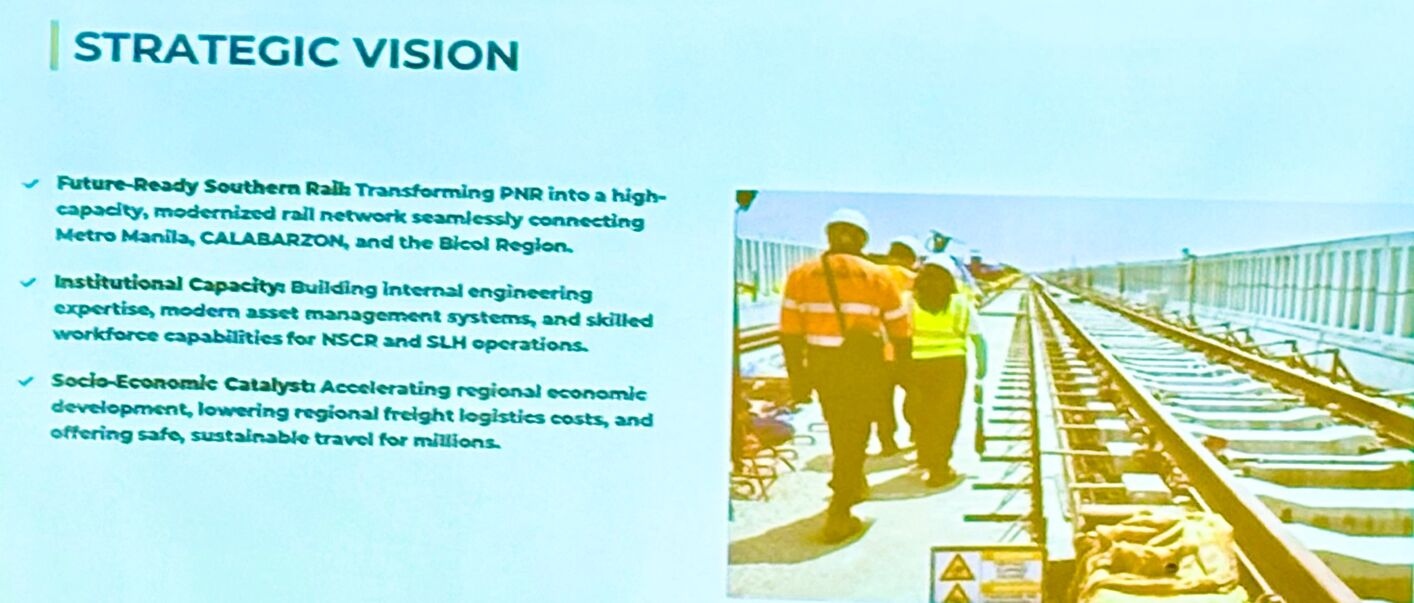
“Our dream by the end of President Marcos’ term is to complete the mainline south from Calamba all the way to Legazpi, alongside a full rehabilitation of tracks and stations,” Miranda said. “If given the opportunity to establish long-haul operations on this 423-km line, we hope—through various funding options or government support—to acquire at least two new long-haul train sets. The rolling stock we currently operate is commuter-type equipment. Even on routes extending over 147 km, we are effectively using urban rail cars similar to LRT-1 and LRT-2.”
Miranda emphasized that physical vulnerabilities present continuous hurdles.
“PNR faces severe environmental challenges,” Miranda noted. “When I assumed the GM role, the first major calamity we encountered was Typhoon Kristine. Three of our operational train sets in Naga were completely submerged by floodwaters. Through a bayanihan effort by our mechanics, mechanical engineers, and technicians, we restored two of those submerged sets. They are running safely today, albeit under controlled operational limits.”
The southern PNR network is plagued not only by recurring floods but also by frequent landslides along its Quezon sector.
“As part of our ongoing rehabilitation to build a more reliable 423-km infrastructure, we are conducting fresh geotechnical assessments and soil studies in landslide-prone zones across Quezon and Camarines Sur,” Miranda explained. “This will ensure the line remains operationally viable and climate-resilient for years to come. Maintenance funding also remains a primary bottleneck. Beyond basic repairs, maintaining a 423-km track requires continuous ballast replenishment. In several southern sectors—particularly around Calamba and Lucena—certain track sections have not been reballasted since the 1990s.”
Preparatory investments for mega rail projects
Batan emphasized that substantial upfront preparation is required before mega infrastructure can break ground.

“For the NSCR and the Metro Manila Subway Project alone, we invested nearly P20 billion just in feasibility study expenses,” Batan explained. “That preparatory spending ultimately unlocked P1.3 trillion in total project investments—P500 billion for the subway and P870 billion for the NSCR. People often don’t realize how much preparation is required to credibly structure a mega project. Globally, the rule of thumb is 1 to 100: One dollar of project preparation resources for every 100 dollars of capital expenditure.”
Batan detailed how the department has expanded its planning capacity over the past decade. “We are currently the largest client of the PPP Center’s Project Development and Monitoring Facility, as well as the largest client of the Asian Development Bank’s PPP advisory group,” he stated. “We are expanding partnerships with the World Bank, the IFC, and other international development organizations across all project preparation tiers. When managing multi-billion-dollar infrastructure, project preparation is just as critical as actual execution.”
When asked by TessDrive how future presidential transitions might impact ongoing rail projects and how project planning can be effectively “president-proofed,” Batan underscored the balance between policy continuity and democratic mandates.
“The President serves as the elected representative of the people. We maintain a pipeline of future rail lines, but determining which ones get prioritized remains a core policy decision made by elected leadership. That will be the key task for future administrations: Choosing the next set of priorities down the pipeline.”
For projects already under construction, however, momentum provides its own protection.
“Once a project reaches a certain phase of implementation, it becomes locked in,” Batan added. “The subway and the NSCR are fully funded and contracted, with construction completion averaging between 40 to 50% across segments. Portions will become operational during this administration, while others will open under the next. We hope to demonstrate that continuity in mega project execution benefits everyone, regardless of political shifts. Continuity has proven vital across past administrations, and maintaining that momentum is essential for the nation’s long-term mobility.”
Closing the forum, SwissCham Philippines Chair Felix Fietcher reinforced the strategic imperative of modern transit systems, noting that “efficient and sustainable mobility is fundamental to economic competitiveness, business growth, and quality of life.”
SwissCham Executive Director Christine Fajardo echoed this sentiment, emphasizing sustained cross-sector engagement: “Mobility is more than a transport issue—it is an economic and quality-of-life imperative that affects businesses, workers, and communities alike. As the Philippines advances its ambitious infrastructure agenda, meaningful collaboration between government and the private sector will be essential to translating policy into practical, lasting outcomes.”
The train may be running so late, but the station has promised us of its arrival. No choice here, but to wait.
Follow the official PNR Facebook page https://web.facebook.com/officialpnrpage/?_rdc=1&_rdr#, or visit the official PNR/NSCR website https://pnrtrain.com/.