

By Tessa R. Salazar
Mazda buyers are drivers rather than just passengers. They don’t buy a car for badge snobbery or purely for utilitarian reliability. They buy it because they appreciate Jinba-Ittai (machine and rider as one in complete harmony). They read the spec sheets. They know what “torque converter-less transmission” means. They are willing to pay a premium for a “feeling” that doesn’t show up on a spreadsheet. They expect the car to feel “human-centric.”
During the Jan. 14 media thanksgiving event at the posh Lakehall at Nena’s Sanctuary at the Sta. Elena Golf and Country Estate in Santa Rosa City, Laguna, Mazda Philippines president and CEO Steven Tan presented the updated Mazda CX-60.
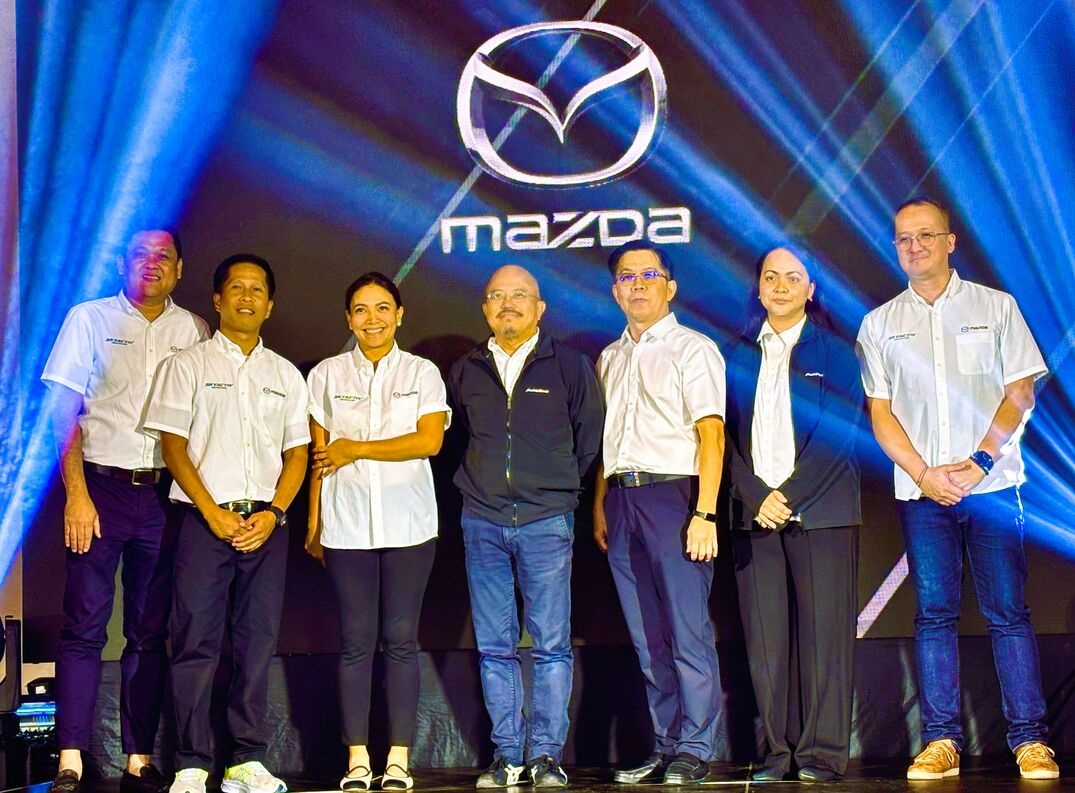
It is, in my impression, a fairly polarizing yet technically fascinating vehicle, made all the more interesting by Tan’s way of “humble bragging” its capabilities.
He gave a presentation that was radically transparent and quite technical during Mazda Philippines’ official announcement of the arrival of the new CX-60. An engineering purist will take note of Mazda’s premium all-hybrid SUV, as significant updates were discussed during the launch, including suspension tuning, steering calibration, drivetrain response, and noise suppression. Mazda Philippines stressed that these refinements are designed to improve ride compliance, stability, and overall balance while preserving Mazda’s signature Jinba-Ittai driving experience.
Top CX-60 market in Asia
Tan proudly announced that since its Philippine launch, more than 800 CX-60 units have been delivered, making the country the largest CX-60 market in Asia outside Japan.
“This is a testament to it being well-received by Filipino buyers,” Tan said. “The new CX-60 enriches that by offering new refinements, making it even more unmatched in every way. These are much more than skin-deep, and are part of our commitment to continuous improvement.”
Issues addressed
Tan admitted, however, that the early models had issues—specifically a “jerky” transmission and “jumpy” suspension. He confirmed that these have been resolved in the IPM (improved product model) units.
This level of honesty is rare for a product launch; usually, officers hype that previous models were perfect. Not Tan, who confronted CX-60’s issues head-on. He acknowledged the early negative reviews, and gave assurances that the problems have been resolved with the IPM, the updated batch of cars whose suspension softness and transmission smoothness have been recalibrated. Tan added that the problems were also resolved for 90% of the customers of the previous models.
Admitting the fix builds trust with Mazda Philippines’ meticulous buyers. The word “fix” in the IPM version may have lured some Mazda enthusiasts to test drive the new CX-60 to feel the difference.
Technical refinements
The press information indicates that the ride experience in the new CX-60 has been significantly enhanced with no sacrifice to the first-rate driving experience. The rear suspension has softer rear springs and new bump stops for improved compliance, while the dampers with increased rebound rates help control vertical motion. The front suspension features dampers with firmer front compression rates and relocated front knuckle mounts for better stability, especially on rough roads. Recalibrated steering and stability systems also improve overall balance.
The press materials expounded on the new suspension, noting that the setup “complements the Large Vehicle Platform.”
“This front-engine rear-wheel drive mechanical layout delivers imposing strength and elegance, but also maximizes the driver’s potential by distributing the lateral and longitudinal workload between the two axles,” the information reads. “Furthermore, by placing the powertrain units at the center, it transmits power to the road surface more efficiently. The unique packaging has reduced its turning radius to a compact 5.4 meters, smaller than other similarly sized SUVs.”
The ‘grown-up MX-5’
Tan also described the CX-60 as the “grown-up MX-5.” While most SUVs have engines mounted sideways (transverse/east-west) to save space. The CX-60 mounts it lengthwise (longitudinal/north-south).
This makes a world of difference. This pushes the weight back (behind the front axle), creating a 50/50 weight distribution. This is why Tan calls it a “grown-up MX-5.” It balances like a sports car, not a nose-heavy SUV. A longitudinal engine makes the car turn better (with that 5.4-meter radius) and handle better due to that ideal balance.
Pundits note that this is a rare touch of engineering in a world of generic electric crossovers.
Fuel economy that needs to be seen to be believed
Another engineering feat performed by the CX-60 led to a somewhat unbelievable result from the Department of Energy’s (DOE) fuel economy run. The vehicle was able to run 50.48 km for every liter of diesel.
The result came after a run at the Tarlac-Pangasinan-La Union Expressway (TPLex) using the 3.3-liter e-Skyactive-D CX-60, with a rated power of 254 PS and 550 Nm of torque. The total distance of the run was 156 km.
Energy department Director Patrick T. Aquino disclosed that the designated route for the 2025 edition of the fuel economy run started at the Petron Service Station at km 134 northbound. The vehicles proceeded to the Rosario toll exit to the Subusub-Rotunda and returned to the Rosario toll entry, then straight to the Petron service station at Km. 134 southbound.
All participating vehicles ran within TPLex speed limits—between 60 and 100 kph. All traffic rules were observed. All vehicle air conditioning thermostats and blower/fan settings were set to medium level or between 22°C and 24°C, and a closed-window policy was utilized.
Tan did not disclose the result to the media until this day. His refusal to use what could be interpreted as “misleading” data may be seen as a good PR move. By saying, “I chose not to publish it because it’s incredible,” he made us believe the result more than if he had just straightaway put it in a media release. He acknowledges that in the real world (with traffic, road inclines, and different driver behaviors), it would be highly unlikely to get the same 50 km/liter result. For Tan, what’s important is that the number only proves that the engine’s massive theoretical efficiency does translate to real world driving economy.
In an era of hype, Mazda is playing the long game of trust. With the official result logged in, the 50.48 km/liter figure is technically attainable (thanks to the 3.3L diesel mild-hybrid coasting ability) but practically impossible in daily driving. And that adds more dimension to the term “aspirational.”
Pricing advantage
The new CX-60 variants are aggressively priced in the Philippines: P2.89 million for the 3.3L AWD HEV Turbo and P2.99 million for the 3.3L AWD HEV Turbo-D Sport.
Compare these prices to our neighbors: The same model goes for a whopping P14 million in the Singaporean market. In Malaysia and Brunei (where they only had rear-wheel drive and a 2.5L engine), prices were pegged at P3.5 million. In Indonesia, it’s P4 million. Here, for P2.9 million, you get the 3.3L AWD engine.
“That’s still cheaper than our neighbors,” Tan quipped. “Thanks to JPEPA, the Philippines can get the same model at such an accessible price.”
JPEPA (the Japan-Philippines Economic Partnership Agreement) is the comprehensive bilateral trade treaty signed in 2006, enforced in 2008, aimed at increasing trade and investment opportunities between the two nations.
The SRP is inclusive of a 5-year free service plan which covers the expenses of periodic maintenance at either 6-month or 10,000-km intervals, for up to 5 years or 100,000 km, whichever comes first. This is on top of a 3-year bumper-to-bumper warranty and a 5-year hybrid battery warranty.
Tale of the tape
Here are more vital statistics of the CX-60:
Enhanced transmission: The Skyactiv-Drive 8-speed automatic has been augmented with clutch control and hydraulic valve improvements. This results in even smoother and more responsive combustion-engine-to-electric motor transitions and a wider gear range for the best balance of enjoyable driving dynamics and environmental performance.
Inline-six power: Powering the new CX-60 is a family of inline-six-cylinder engines, available in both gasoline and diesel variants. This configuration produces less vibration due to its characteristic “perfect balance,” helping it deliver both a smooth and quiet engine tone at low speeds, and a clean and engaging sound at full song. Developed using the “right sizing” concept, the 3.3-liter e-Skyactiv-G delivers 284 PS and 450 Nm, while the 3.3-liter e-Skyactiv-D offers 254 PS and 550 Nm.
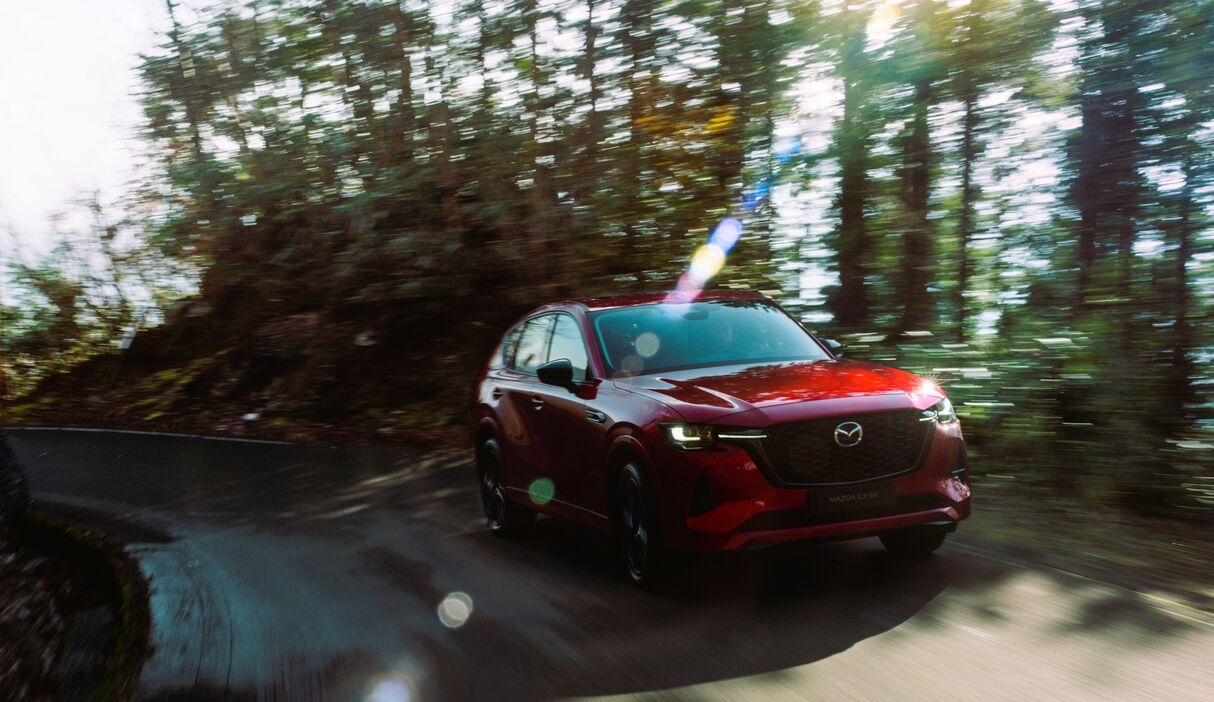
Hybrid tech: Both engines utilize Mazda Hybrid technology with a 48-volt hybrid system and lithium-ion battery pack.
Interior refinement: New on the CX-60 are additional refinements to its already impressive levels of noise, vibration, and harshness (NVH). The sound insulator material used on the dashboard is thicker and denser, with increased coverage that now includes the upper part of the cowl. The trunk side trim also has increased sound insulator coverage. A new steering column joint and reinforced doors further reduce unwanted interior vibrations.
You can check the Mazda Philippines social media page or visit its 13 dealerships nationwide for more details. Bermaz Auto Philippines Inc (Mazda Philippines) is the exclusive distributor of Mazda vehicles and parts in the Philippines. The company’s after-sales service record has been ranked number one in the industry twice—in the 2016 and 2019 JD Power Customer Service Index Study.

To know more about the CX-60, and the rest of Mazda’s roster of vehicles available in the country, visit Mazda Philippines’ official website https://www.mazda.ph/.
Banner composite image shows Mazda Philippines president and CEO Steven Tan finally revealing astounding fuel economy results for the CX-60