
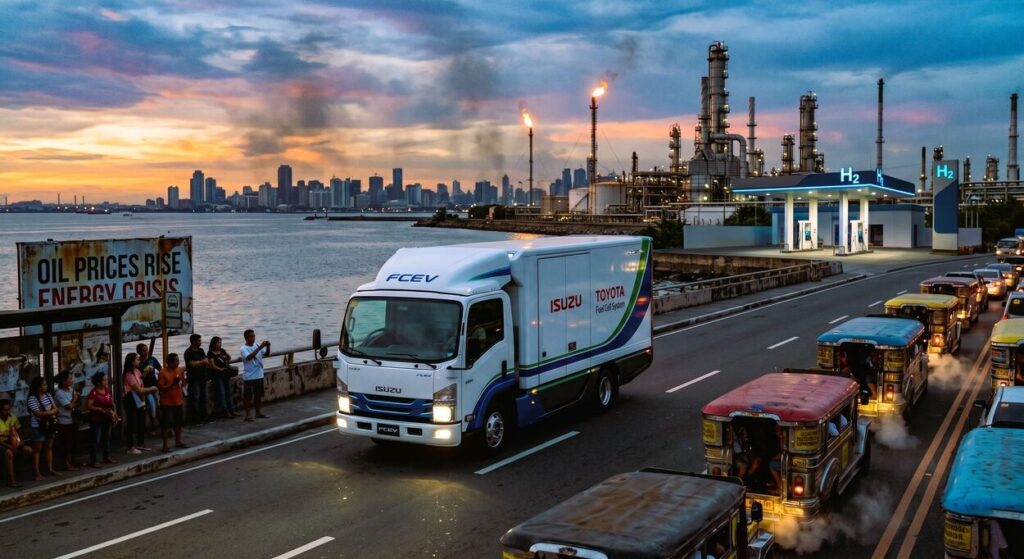
As geopolitical tensions in the Middle East—specifically the friction between Iran, the United States, and Israel—send ripples through the global oil supply chain, the urgency for energy-independent logistics has never been higher. For the Philippines, a nation hypersensitive to pump price hikes, the latest move from Japan offers a glimpse into a post-fossil-fuel future.
The Isuzu-Toyota alliance
Isuzu Motors and Toyota Motor Corp have announced a joint venture to mass-produce Japan’s first light-duty fuel cell electric truck (FCET) by 2027. This isn’t just a prototype but a strategic shift. By integrating Toyota’s 3rd-generation fuel cell system into Isuzu’s established ELF EV platform, the duo aims to solve the “downtime” dilemma that currently plagues battery-electric trucks (BEVs).
In the Philippine setting, where “last-mile” delivery trucks often run 24/7 to supply supermarkets and cold-chain facilities, the limitations of BEVs—long charging hours and heavy batteries—are glaring.
FCEVs (fuel cell electric vehicles) offer three distinct advantages:
o Rapid refueling: Hydrogen tanks can be topped up in minutes, comparable to diesel, keeping logistics moving;
o Extended range: High-energy density allows for long-haul routes without the weight penalty of massive battery packs;
o Zero emissions: Like BEVs, they emit only water vapor, aligning with the Philippines’ push for cleaner air in congested urban hubs.
But what about hydrogen extraction?
While the technology is promising, the path to a “hydrogen society” is uphill. Extracting hydrogen remains energy-intensive, and the infrastructure for processing and retailing it as transport fuel is currently cost-prohibitive for many developing markets.
Currently, most hydrogen is “grey” (derived from natural gas), which doesn’t fully solve the carbon or fossil-fuel dependency. The industry is racing to transition to “green” hydrogen—produced via electrolysis powered by renewables like solar and wind—to truly decouple transport from Middle Eastern oil volatility.
Building the ecosystem
Isuzu and Toyota are focusing on durability and cost reduction. Isuzu is optimizing vehicle body structures, while Toyota innovates the stack manufacturing process to bring prices down to a commercial reality.
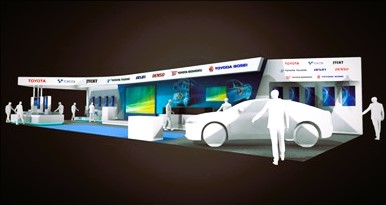
(International Hydrogen & Fuel Cell Expo) held at Tokyo
Big Sight March 17 to 19, 2026
(Image from global.toyota/en/newsroom)
Looking toward the horizon of 2027, the goal is clear: Transforming the humble delivery truck from a diesel-chugging necessity into a clean, hydrogen-powered pillar of a stable, carbon-neutral economy.
This article was adapted from a news release by Toyota Global. For the original article and further details, click here: https://global.toyota/en/newsroom/corporate/44232994.html?utm_id=97758_v0_s00_e0_tv0&fbclid=IwY2xjawRNOfFleHRuA2FlbQIxMABicmlkETFXYTJrUmZDRnNHc0RzYUswc3J0YwZhcHBfaWQQMjIyMDM5MTc4ODIwMDg5MgABHkt5H7ty-CGqf62PPMPsX41xXpWBcVemgJwP09BFCcxjCN6DYrxu6LjNpnIC_aem_8af5ES6urmRotmgLR87grw